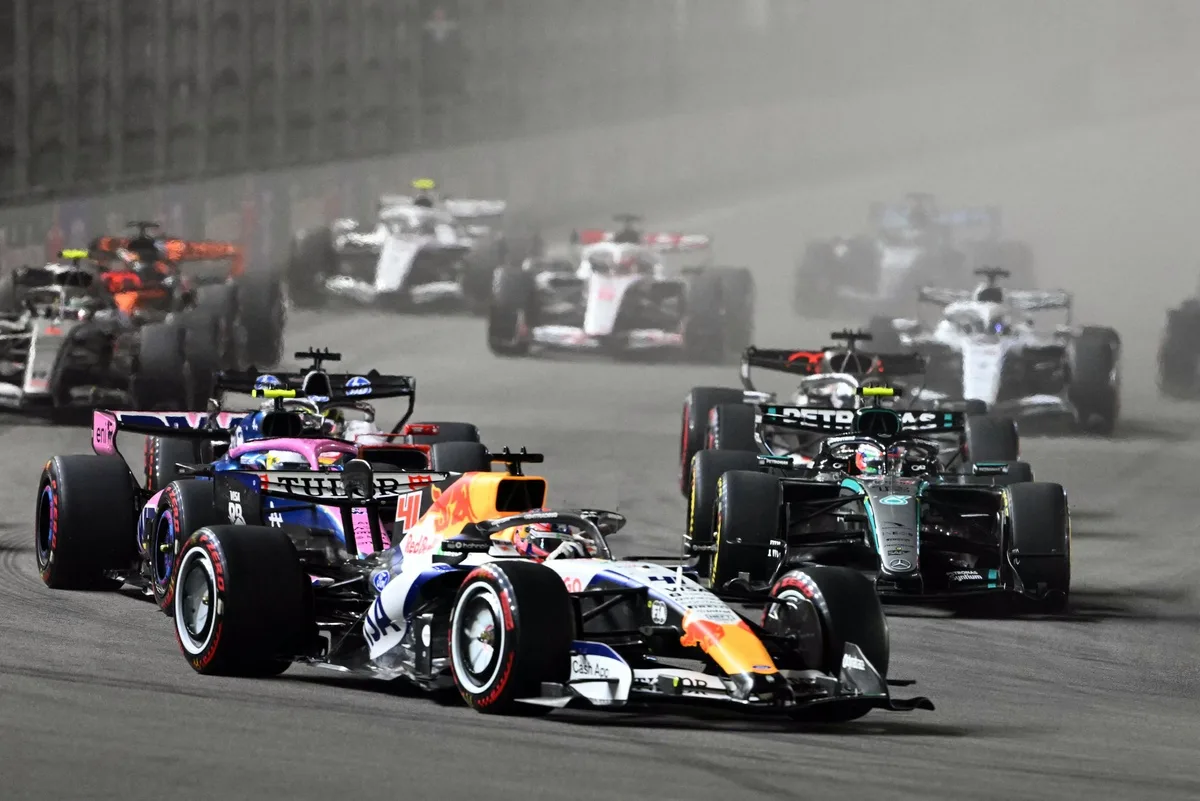
LONDON — Formula 1 manufacturers will be barred from performance development of the current hybrid V6 power units from the 13th race of the 2028 season, with only reliability updates permitted thereafter. The freeze, confirmed by FIA single-seater director Nikolas Tombazis in an exclusive interview with Motorsport.com, is designed to manage the transition to the 2.1-litre turbocharged V8 for 2030.
The measure, first revealed by Motorsport.com over the Las Vegas Grand Prix weekend, is intended to stop manufacturers running two costly projects simultaneously and to prevent any rival gaining an undesirable advantage. For the same reason, work on the 2030 V8 is largely prohibited until the same point, with no single-cylinder dyno work allowed until 1 October 2027 and no full power unit dyno work permitted until 1 July 2028.
The restrictions do not apply to newcomers, meaning General Motors will be allowed to carry out simulation work for their Cadillac power unit earlier. "We need to consider this whole topic in relation to our intention and what we've discussed with the PU manufacturers, so to freeze the current generation of engines from a certain point onwards," Tombazis said. "That will be mid-2028. What we want to avoid for cost reasons is that they have two parallel programs."
Tombazis said the FIA also want to avoid a scenario where a manufacturer that is very competitive now can stop current development early and focus on 2030, while a chasing rival — such as Honda — remains behind at the freeze. "What we also want to avoid is that some of the current PU manufacturers may get a significant advantage if they are very competitive at the moment," he said. "Clearly, we need to give the opportunity for as much convergence as possible before that time. We don't want somebody to be frozen and to be way down."
The freeze has been confirmed and agreed with all parties involved, but Tombazis said work on the ADUO convergence mechanism remains incomplete. "We've been concentrating on the PU framework and, frankly speaking, we are a bit late on the ADUO side," he said. "So, we have this topic to address and all of that is related to ADUO as a discussion point."